SUMMARY: Is Flutter really the future of mobile development? Does it win the race with React Native? The answer is Yes. Although both frameworks are truly exceptional for developing mobile apps, Flutter offers many advantages that can help us develop applications with a great user experience, and do it faster, allowing save time and money.
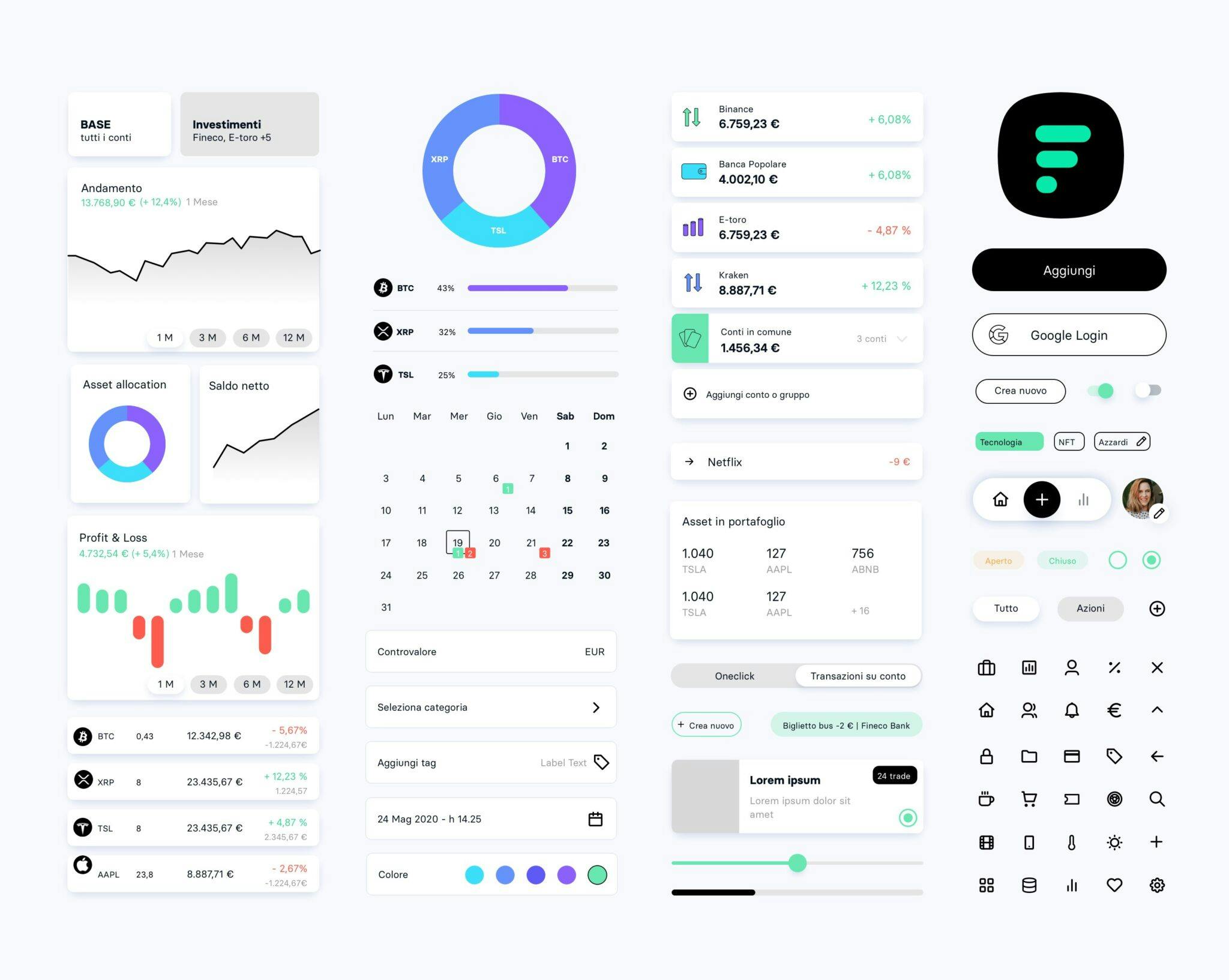
the FinHub design system – one of the latest mobile applications in Flutter developed by glueglue
What is Flutter and how is it different from React Native?
Flutter is an open-source framework developed by Google for building cross-platform native apps. It is based on the Dart programming language and provides a wide range of tools and libraries for creating modern and engaging user interfaces. One of Flutter's distinctive features is its "everything is a widget" architecture, which allows for flexible and responsive user interfaces.
Unlike Flutter, React Native is a framework developed by Facebook that enables developers to create native apps using JavaScript and React. React Native employs a component-based approach to create user interfaces. Unlike Flutter, React Native uses predefined native components for iOS and Android, allowing apps to have a more consistent look and behavior with each platform's native guidelines.
One of the main differences between Flutter and React Native lies in how apps are executed. Flutter utilizes its rendering engine that draws the entire UI, thus providing fast and consistent performance across different platforms. On the other hand, React Native uses a "bridge" approach that communicates between JavaScript code and native components, which might result in slightly reduced performance compared to Flutter.
Flutter website's homepage
Flutter vs React Native
When it comes to technology trends for cross-platform mobile application development, both React Native and Flutter are quite similar in terms of popularity and both are still quite young. React Native was released in 2015, Flutter in 2017. We can see that interest in Flutter has increased significantly in 2021 and is growing rapidly. On a technical level, React Native uses a JavaScript approach while Flutter uses Dart as a programming language.Gluto – App Flutter per iOS

Gluto - App flutter Android

What are the benefits of building mobile apps with Flutter?
- Single codebase: Flutter supports both Android and iOS platforms, allowing you to write code once and run it on both. This saves time and effort, while ensuring consistent experiences across platforms. For example, our Flutter app, Gluto, quickly became one of the top 100 food apps globally, with a rating of over 4.5 stars on both the Play Store and App Store.
- Rapid UI development: Flutter's UI is built using widgets, which are small building blocks assembled using a technique called composition. Similar to React components, this approach enables you to create beautiful interfaces in no time. You can choose from two sets of ready-to-use widgets: Material Design for Google's guidelines and Cupertino for Apple's iOS guidelines.
- Pixel-perfect rendering: Flutter takes care of rendering every pixel on the screen, ensuring consistent appearance across devices, including older ones. This eliminates potential device compatibility issues, allowing you to create stunning user interfaces that look the same on Android and iOS using a single codebase.
- Fast development: Flutter shines in its ability to provide hot reload, allowing you to make instant changes and see the results immediately during development. This feature significantly speeds up the app development process and enhances productivity.
- Cross-platform capabilities: Flutter SDK is a powerful tool for developing apps not only for mobile devices but also for desktop and web platforms. With a single codebase, you can create visually appealing and interactive user interfaces using Flutter's widgets, layers, and resources.

MVP prototype in Sketch
Is Flutter suitable for MVP development?
In the development process, MVP (Minimum Viable Product) is an important step before the product becomes a fully-fledged app. Such an approach offers several advantages (we explain all the steps in this article).
Saves time, money, and resources.
Allows us to test business and product ideas and receive quick feedback from your user base.
Helps prioritize tasks and separate essential features from useful ones.
Flutter helps save development time primarily due to its cross-platform support, eliminating the need for platform-specific codebases.
Furthermore, the hot reload feature, which greatly assists in adding new features or fixing bugs using real-time debugging, makes Flutter a highly efficient tool.
These qualities make it a highly appealing mobile framework when considering the technology to use for MVP or POC (Proof of Concept) development.
Are there any drawbacks to using Flutter?
It has limitations in terms of rendering the user interface on native platforms, such as video on Apple TV or Android TV.
Features that have been recently introduced in native iOS and Android systems will naturally be implemented in Flutter later compared to native versions.
Although Flutter is relatively easy to learn, you may still need a development team with some experience to create a functional cross-platform app.
Advantages of React Native
React Native is a mature framework that has made a name for itself in the mobile development world. What are its main advantages?
- It is a mature framework with stable APIs, supported by Facebook.
- It is easy to learn for React and JavaScript developers. You can leverage existing React libraries, tools, UI frameworks, and tutorials. The framework also has a strong community.
- Just like Flutter, it enables rapid development for iOS, Android, and the web with a single codebase.
- React Native allows you to add new code to a running app, reducing the risk of losing certain features during a full reload or rebuild of the app.
Disadvantages of React Native
Some platform-specific custom modules are still missing, and you may need the expertise of a native developer to create them.
Navigation may not be as smooth, and cross-platform development may cause performance and device-related issues.
It is not the best choice for apps that include complex games or elaborate animations.
Flutter or React Native: Who is the winner?
We have already covered the essential features of Flutter and how it differs from other cross-platform frameworks, so the question remains: Is Flutter truly the future of mobile development? Does it outperform React Native? The answer is Yes.
While both frameworks are exceptional for mobile app development, Flutter offers many features that can help us create visually appealing mobile applications with a better user experience, and do it faster, saving more time and money.
Many sources, citing the steady increase in Flutter's popularity over the past two years, predict that the trend will continue in 2022 and beyond.
Is Flutter the future?
Of course, every application has its own peculiarities, and choosing the right technology is something that should be discussed from the beginning with the rest of the team, so that the final decision is made based on the pros and cons of all the considered solutions.
Flutter has already made a name for itself in the mobile app development world, and 2022 will likely see further significant growth.
Are you interested in developing a digital product with Flutter? Drop us a line!